Whale Activity Tracker: Follow the Giants
Monitor large cryptocurrency transactions and whale behavior. Understand when big players are accumulating or distributing to time your trades better.
What are Crypto Whales?
In the cryptocurrency ecosystem, "whales" refer to individuals or entities that hold large amounts of a particular cryptocurrency. These large holders have the potential to influence market prices through their trading activity, making their behavior an important signal for other market participants.
For Bitcoin, a whale might hold thousands or tens of thousands of BTC. For altcoins, whale status depends on the token's total supply and market cap. What defines a whale is their ability to move markets – when they buy or sell, prices respond.
Whales include early adopters who accumulated during the early days, institutional investors like hedge funds and family offices, cryptocurrency exchanges, protocol treasuries, and ultra-high-net-worth individuals. Their collective behavior provides valuable insights into potential market direction.
Types of Whale Activity
Understanding different patterns of whale behavior helps you interpret market signals.
Accumulation
Whales are buying and increasing their positions. Often precedes price rallies.
Distribution
Whales are selling into strength. May signal upcoming price weakness.
Rotation
Capital moving between assets. Watch for where whales are rotating to.
Neutral
No significant whale activity detected. Normal market conditions.
Why Track Whale Activity?
Whales often have access to information, resources, and analytical capabilities that retail investors lack. While past performance doesn't guarantee future results, whale activity can provide useful data points for your investment decisions.
When whales accumulate an asset, it suggests they believe the current price offers good value. Accumulation is typically characterized by large purchases spread over time to minimize market impact. Detecting accumulation patterns early can help you enter positions before significant price appreciation.
Conversely, whale distribution often precedes price declines. When large holders begin selling, even if prices are still rising, it may signal that the "smart money" is taking profits. Recognizing distribution can help you avoid holding through major corrections.
Additionally, tracking whale movements between assets (rotation) can reveal emerging trends. If whales are moving capital from Bitcoin to specific altcoins, or from one sector to another, it might indicate where opportunities are developing.
How We Detect Whale Activity
Our whale tracking system analyzes multiple on-chain and market data sources to identify whale behavior. We look at large transaction volumes, unusual trading patterns, and changes in top wallet holdings to build a comprehensive picture of what big players are doing.
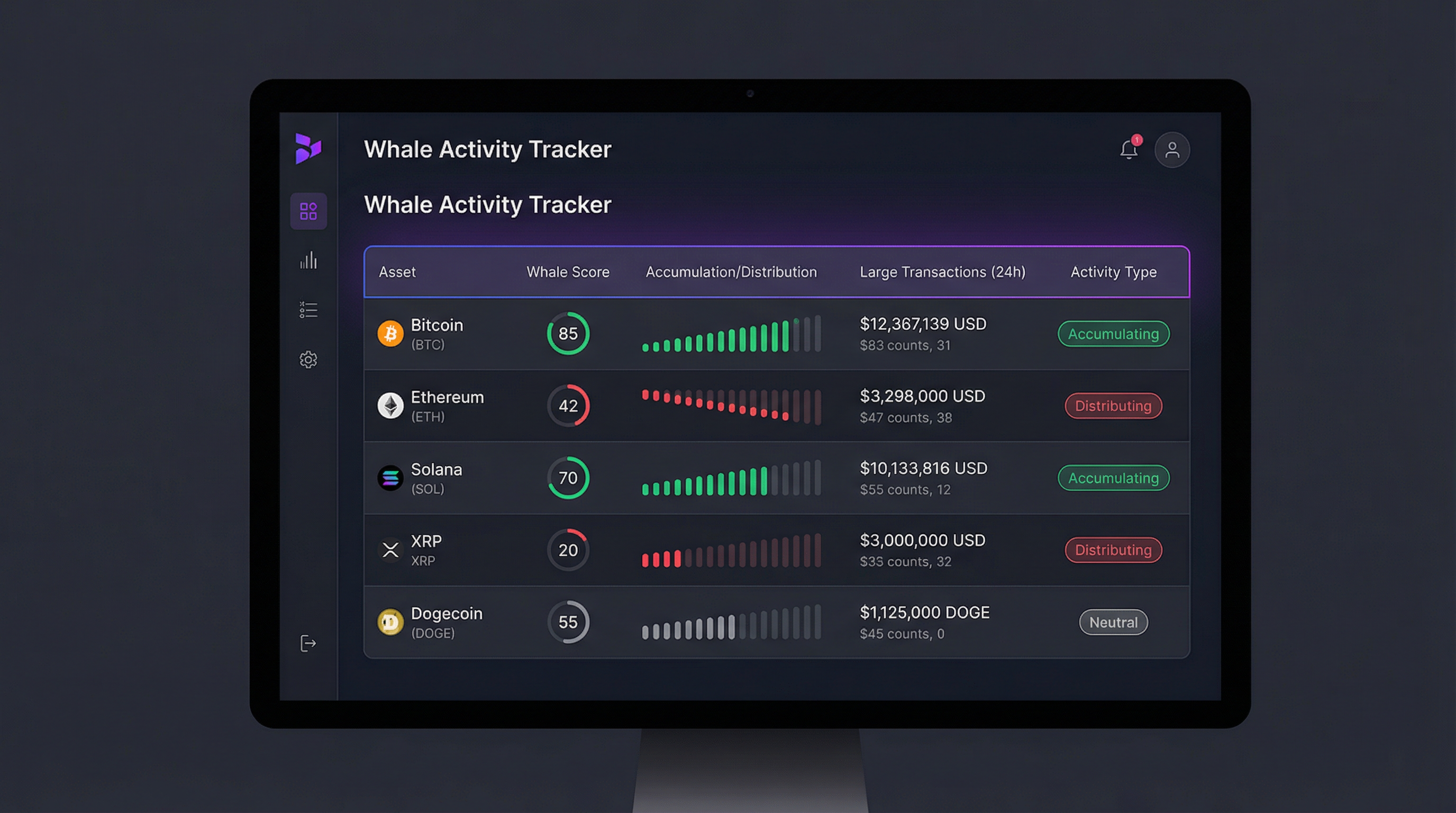
For each cryptocurrency, we calculate a "Whale Score" that represents the intensity of whale activity. This score considers both the volume of large transactions and their directional bias (buying versus selling). A high score with accumulation bias is bullish; a high score with distribution bias is bearish.
We also track the estimated number of large transactions over the past 24 hours, giving you a sense of how active whales are in each market. Sudden spikes in large transaction counts often precede major price moves and deserve attention.
Our system classifies each asset's whale activity into categories: Accumulation, Distribution, Rotation, or Neutral. These labels provide a quick summary that helps you understand current whale behavior at a glance.
Common Whale Behavior Patterns
Understanding common whale tactics helps you interpret their activity more accurately. Whales rarely buy or sell their entire position at once – this would move the market against them. Instead, they use various strategies to execute large positions while minimizing price impact.
Accumulation often occurs during periods of fear when retail investors are selling. Whales use this selling pressure to build positions at favorable prices. You might see large buy orders absorbing sell-offs, or steady purchasing during consolidation periods.
Distribution typically happens during euphoria when retail FOMO creates buying pressure that whales can sell into. The market may be making new highs, but whale distribution signals that smart money is exiting. Eventually, without whale support, prices often decline.
Rotation involves whales moving capital from one asset to another. This might be from Bitcoin to altcoins during altcoin season, from older projects to newer narratives, or from risky assets to stable ones during uncertainty. Tracking rotation helps you identify where capital is flowing.
Using Whale Data in Your Strategy
Whale data is most valuable when combined with other indicators. Consider whale activity as one input alongside price action, money flow, market sentiment, and technical analysis. When multiple signals align, conviction increases.
For potential entries, look for assets showing whale accumulation during periods of fear or consolidation. These conditions suggest whales are positioning for an expected move while retail sentiment remains negative – often a contrarian opportunity.
For exits, monitor your holdings for signs of whale distribution. Even if prices are still rising, increasing distribution activity suggests the rally may be mature. Taking profits alongside whales rather than waiting for a crash can protect your gains.
Remember that not all whale activity is predictive. Sometimes large transactions are simply internal transfers, exchange movements, or unrelated to directional bets. Our system filters out obvious non-trading activity, but interpretation still requires judgment.
Important Considerations
While whale tracking is a valuable tool, it's not a crystal ball. Whales can be wrong – they sometimes accumulate assets that decline or distribute before further gains. Use whale data as one of many inputs rather than as a sole decision-maker.
Market conditions matter. In strong bull markets, accumulation signals tend to be more reliable as momentum favors bulls. In bear markets, distribution signals may be more actionable. Adjust your interpretation based on the broader environment.
Timing is challenging. Whale accumulation might precede a rally by days, weeks, or even months. Distribution can begin well before a top. Don't expect immediate price reactions to whale activity – view these signals on longer timeframes.
Don't Trade Blind – Track the Whales
Access real-time whale activity tracking and gain insights into what big players are doing. Create your free account and start whale watching today.
Create Free Account